The banana has an excellent reputation. It is convenient, naturally sweet, easy to digest and quietly reassuring. You don’t need to cook it, toast it, soak it or ferment it. You just peel it and eat it. For many people, that already qualifies as a proper breakfast.
Nutrition experts, however, tend to look at bananas with a little more distance.
A banana is nutritious — no argument there. It contains potassium, vitamin B6, vitamin C and a reasonable amount of fiber. According to the U.S. Department of Agriculture, a medium banana provides about 3 grams of fiber and roughly 27 grams of carbohydrates. What it does not provide in meaningful amounts are protein and fat — two macronutrients that play a key role in how stable your energy feels during the morning.
That’s where the debate begins.
Why a Banana Alone May Not Be Enough
A banana is nutritious — no argument there. It contains potassium, vitamin B6, vitamin C and a reasonable amount of fiber. According to the U.S. Department of Agriculture, a medium banana provides about 3 grams of fiber and roughly 27 grams of carbohydrates. What it does not provide in meaningful amounts are protein and fat — two macronutrients that play a key role in how stable your energy feels during the morning.
That’s where the debate begins.
Registered dietitian Kathy Warwick, RDN, CDCES, explains that while bananas are rich in valuable micronutrients, they are also relatively high in natural sugars. When eaten on their own, especially first thing in the morning, they can cause a rapid rise in blood sugar followed by an equally rapid drop.
That drop often shows up as fatigue, irritability or sudden hunger — sometimes all three at once.
Dr. Daryl Gioffre, nutrition expert and author focusing on metabolic balance, puts it more bluntly. He points out that bananas are composed of roughly 25 percent sugar and are quickly digested. “When you eat a banana by itself, you may get a quick burst of energy,” he says, “but it doesn’t last long, and that can leave you reaching for more food not long after.”
This doesn’t make bananas bad. It makes them incomplete.

The Problem Isn’t the Banana — It’s the Context
Modern nutrition advice often fails not because it is wrong, but because it is oversimplified. Foods are labeled as good or bad, healthy or unhealthy, without much regard for timing, combinations or individual metabolism.
A banana eaten after a workout behaves differently than a banana eaten alone at 7 a.m. A banana paired with protein behaves differently than a banana eaten on its own.
Several studies on glycemic response show that carbohydrates consumed together with protein or fat lead to a slower rise in blood glucose and a longer-lasting feeling of fullness. This is why nutritionists repeatedly emphasize balance rather than restriction.
In practical terms, this means one thing:
The banana should not be lonely.
What Happens When You Add Protein and Fat
When you combine a banana with a source of protein — such as Greek yogurt, cottage cheese or nut butter — digestion slows down. Energy is released more gradually. Hunger stays away longer. Cravings tend to be quieter.
Healthy fats, such as nuts or seeds, add another layer of stability. They don’t spike blood sugar and they help regulate appetite hormones.
This combination is especially important for women, whose blood sugar fluctuations can affect mood, concentration and hormonal balance more strongly than we are often told.
In other words, the banana works best when it is part of a team.
When a Banana Can Actually Be a Smart Choice
There are situations where a banana alone makes sense. Athletes sometimes use it as quick fuel before or after training. People with sensitive digestion may tolerate it better than heavier foods early in the day.
But for most people living a normal working day — sitting, thinking, commuting, dealing with emails and deadlines — breakfast needs to do more than just exist. It needs to sustain.
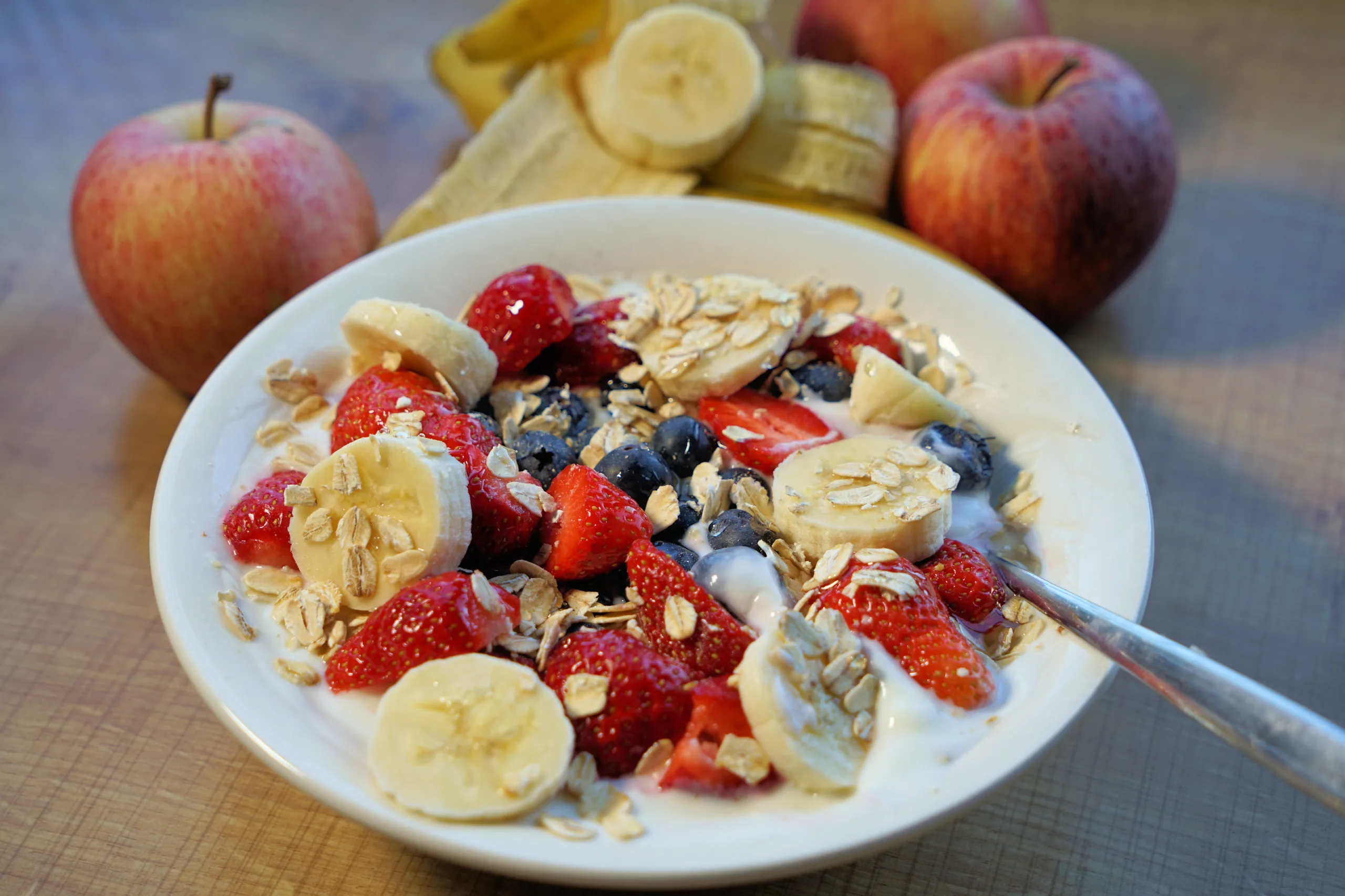
How to Eat a Banana for Breakfast
Here are a few simple combinations that nutrition experts consistently recommend. Nothing fancy. No powders you can’t pronounce.
1. Banana with Greek Yogurt and Nuts
Protein from yogurt slows sugar absorption. Nuts add fat and crunch.
Why it works:
Stable energy, good satiety, and calcium for bone health.
2. Banana with Nut Butter on Whole-Grain Toast
Almond or peanut butter provides protein and fat, whole grains add extra fiber.
Why it works:
Balanced macronutrients and a slower digestive curve.
3. Banana Smoothie — Done Properly
A smoothie is only as good as what you put into it.
Base idea:
- 1 banana
- Greek yogurt
- A handful of berries
- Chia or flax seeds
Why it works:
Fiber, protein and antioxidants prevent the sugar spike that fruit-only smoothies often cause.
4. Warm Banana Oatmeal
Ingredients:
- Rolled oats
- Half a banana mashed into the oats while cooking
- Chopped walnuts
- A spoon of yogurt on top
Why it works:
Comforting, filling, and far more sustaining than fruit alone.
The Bottom Line
Yes, you can eat a banana for breakfast. But eating it alone is more of a shortcut than a strategy.
Nutrition experts agree on one thing: the banana itself is not the problem. The problem is expecting one piece of fruit to do the work of a full meal.
Pair it wisely, and the banana becomes exactly what it should be — a useful, nourishing part of breakfast, not a nutritional illusion.
Sources:
https://www.madisoncountymagazine.com/
https://www.mirror.co.uk/
https://www.medicinenet.com/
https://www.nestarneme.cz/